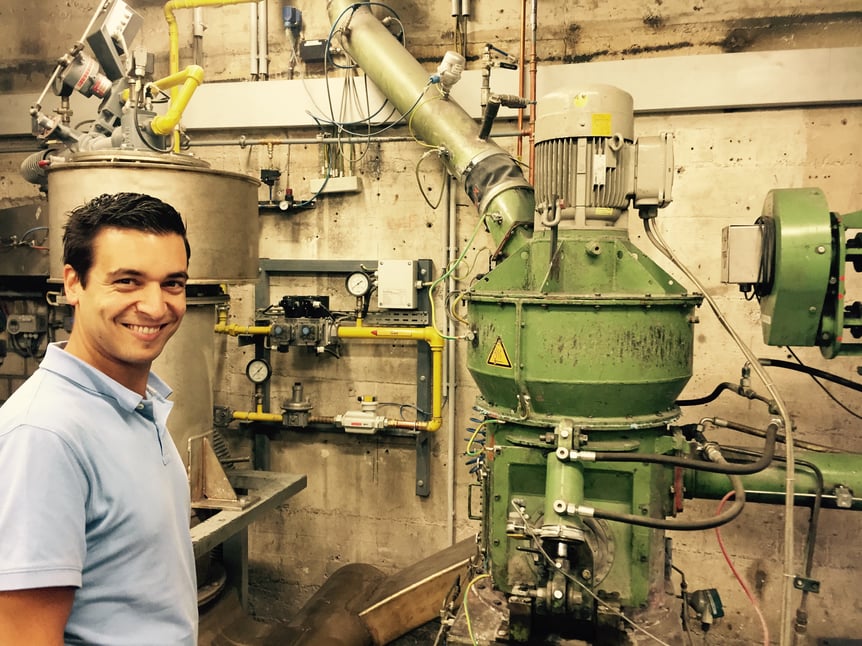
Back in 2009 I visited a small place in the north of the Netherlands called Farmsum. Together with my dad, I travelled the approx. 264 km’s from another small village in the south of the Netherlands, our hometown Nieuw-Bergen, where he started N+P over 30 years ago. I just finished school and together with my other brother Stijn we plummeted into the wonderful world of waste. I was intrigued by what I saw in Farmsum, a brand-new factory was being constructed where waste would be processed into pellets, those pellets could substitute coal at almost all industries; I loved it.
Back then, N+P was the main input supplier of what was then known as Qlyte. We supplied waste into the factory, and “they” would turn it into an alternative fuel which was going to be supplied to a lot of different industries to reduce their fossil fuels consumption. Unfortunately, as with many new initiatives it wasn’t as easy as it first looks. Because what advantage do pellets bring for the cement industry, if there are so many different suppliers of unpelletized material which can do exactly the same thing as pellets: substitute fossil fuels. That was the widespread consensus in this industry back in the days. Combine that with an economic crisis, shortage of waste and other many challenges and you have another “failed” project going bust. Or not? I remember very well the discussions we had in the office and at the family table: continue or stop?! Luckily, we all agreed that this concept could make a difference, as long as we would do it in the right way. Because if you continue doing what everybody else is doing, you’ll just be one of many. So how do we make a difference which really adds value, that’s exactly what we started learning from the journey of Qlyte. I didn’t know it back then, but it would be the start of an amazing journey on which I am still on today, although with a bit more experience or as my respected colleague Neville would say: I have the scars on my back.
Fast forward to 2012.
Unfortunately, Qlyte continued to struggle, and it was basically the end of the road for them. But with an entrepreneurial vision and some courage, my father decided to step in and we took Qlyte onboard into the N+P family. To put that into perspective, the site lost over 200k per month at the time. All of a sudden, I was made responsible for a factory which employed a lot of people with families at home, and it wasn’t in a particular good shape. But at the same time, we saw so many opportunities to bring this concept into the world and really show the industry the benefits of high-quality alternative fuels, we just had to do it! But we needed to think holistically, what do the people need, what does the installation need, but also what does the market and industry want. Because you can think of many beautiful and exciting things, if there is no market for it, it won’t fly. And everyone is already producing SRF (Solid Recovered Fuel) and the market is overflooded with it. So how do we make a difference? It is exactly that situation which has been a very good foundation to further shape the DNA at N+P. To be entrepreneurial, innovative and creative, with a market focused solution in mind.
In the ideal world, you have just one solution which fits everyone’s installation at all different industries like cement, lime, steel and power. But that would be like producing coal. As many before me have already found out, “making” coal substitutes is not easy when working with waste. It’s a lot easier to do it with things like wood, but then again, the commercial challenge peaks around the corner which quickly turns that option into dreams. We had to think how can we change the way we produce a fuel, to make it better suited for a specific client or a specific industry. Thinking in reverse. Not starting from what we make today, but from what the end user needs and how we can meet those requirements with our products. That’s why in 2012 we already started experimenting with milling the fuel, as this would tackle a big issue which many clients were facing: handling. We trialled many different things and many different mills. I once had to fill a big bag of coal by hand at a power plant in Germany because we were trying to mill cokes instead of coal together with Subcoal pellets, that’s how you learn about hard grove indexes and cokes really didn’t work out. Coal did though! But those tests helped us to get clients convinced to trial at scale at their sites, which has led to some very interesting results at various cement and power plants across Europe. It’s those events that help educate yourself and steer you in the right direction, even if there is no direct follow up from a successful trial.
New industries were identified and approached, there must be more than just the cement guys which can use our fuel right? By doing this, new applications for pellet utilising were growing and growing. But even then, you keep learning, you can do a fantastic trial which tick all the boxes, if the “site” doesn’t want to change, nothing else will happen. If a plant manager asks for a full haz suit for their staff to receive one truck of “waste” pellets, you know you are in for a difficult journey. We once supplied a boat of pellets to a power station, with very good results, but when the policy of a country is changed all of a sudden that trial is useless. All of a sudden it’s better to burn white wood pellets because of subsidies, even though Subcoal was shipped from a 100 km’s away and the wood pellets are imported from Canada. The subsidy also didn’t allow any other fuel to be burned next to 95% biomass, great!... Many parties approach you as they want to change their fuel mix. Probably one of the nicest questions I remember is one from an organisation asking us to produce an alternative to power steam locomotives. We even had a test run with a small train running on Subcoal for a very small trial – it was great to see, but obviously it’s not something you can do at scale and within the set boundaries of the regulations. After a few years of R&D, I became known as the “cost” of the company, a joke which my father still makes today. Trials cost money and investing in trials is expensive. I was declared an outlaw (as a figure of speech) for trailing to produce 6mm pellets instead of the bigger ones which were made; today its more then 75% of our output. After all those years, my office became a museum of jars and closets full of trial material, which is often displayed to people who visit us. It symbolizes the long journey we have travelled to get to where we are today, and it always brings a small smile on my face when that happens.
Another fast forward to today, 2026.
The original Qlyte plant could make something like 40kton of pellets in a year. That’s something we now do in less than two months, and in a “bit” of a more efficient way as well. Our R&D process has been professionalised, to start with we have a whole department which we call Technology & Innovation, which I am proud to lead every day. But our basis remains the same. How can we make a difference? With the quest for decarbonisation continuing, its not just about making a difference at your own production sites, it is also about making a difference in the industry. You have to keep holding on to ideas which you believe which can make a difference. Development takes time, effort and a lot of patience and virtue. Even if you think you managed to tick all the boxes, there will always be a new box appearing when you’re about to sign a contract for supply. Unexpected wear costs, a specific species of heavy metals, ash deformation temperatures, contaminated trucks which supply your loads, you name it, we’ve seen it.
So, what’s next?
In the last months I have been sharing two of the workstreams we are spending a lot of time and effort on via my LinkedIn page. Our Pulverized Alternative Fuel or PAF workstream, and the new perspective on biogenic feedstocks. Both streams are R&D based approaches to problems which are very well known in the market, offering solutions for these questions will make a difference. That’s what always on our minds. How can we make a difference that really helps the quest for decarbonisation of the industry.
As a front-runner, we always like to share our innovations and progress, but we are also aware of copycats. Nevertheless, in the coming months, we will continue to share new perspectives through videos, blogs, and interviews to take you on our R&D journey from concept to realization.